Author: Vedette Global Media

  • Poetry and Positive Psychology

    Poetry and Positive Psychology

    Written by Michael Teferi

    The written word, specifically as it related to the art of poetry has existed for many generations.  My high school, for example, gave me a wonderful version of reality back in 1996, when my classmates and I were taught by our English teacher about the classic and modern poetry authors of the past and present, in addition to the unique Poet Laureates.  Persons, such as Robert Frost, Maya Angelou, Langston Hughes, and our youngest Poet Laureate, Amanda Gorman, swayed victorious against their proclivities and brought wisdom of the ages through their words and deeds.

    Positive Psychology on the other hand, is the scientific stop helping people thrive via human flourishing.  Wonderful ideas such as meaning, purpose, inspiration, character strengths, growth mindset, meditation, happiness, and social anxiety have developed and grown into true science and neuroscience books and scientific studies that resonate with the human condition.  Most importantly, Psychologists have found that people tend to associate themselves with different types of connections when they experience opportunities for learning new things, especially from a particular environment from a standpoint of understanding neuroplasticity.

    Fortunately, there exists qualified evidence from Professors, Authors, and Psychologists that provide amazing details of action.  Professors such as Todd Kashdan, Ph.D., Professor of Psychology at George Mason University’s Well-Being Laboratory, provide evidential bases for understanding and applying facts and support for scientific theories and methods that help people showcase ideas in the realm of Character Strengths, Social Anxiety, and Curiosity, which give credence and credibility to their work as students across the field of Psychology, especially Positive Psychology, entail opportunities for experiential learning on purpose.

    My own experiences have shown me that as a graduate of George Mason University after having been inducted into Psi Chi-The International Honor Society of Psychology and The Honor Society of Phi Kappa Phi thereafter in March 2012 and April 2012, respectively, and then experiencing the tribute of achieving the Bachelor’s degree of Psychology in May 2012, it is with tremendous pleasure and privilege that such contributions to the field of education provide quality over quantity, strength of conviction, and love for pure, unadulterated wisdom can easily be attributed to why people do what the do and how much you can learn from courses such as The Science of Well-Being/Character Strengths from Todd Kashdan, Ph.D., Psychological Fitness from Dr. Jerome Short, Ph.D.,, and Cross-Cultural Psychology from Eric Shiraev, Ph.D., showcase how we are using processes and practices to improve the way people see themselves in everyday situations that allow others to be better than they can possibly imagine.


    My name is Michael Teferi, I am a BIPOC Poet, Writer, Positive Psychology Coach, Debut Poetry Book Author, & Podcast Host. Please feel free to contact me by email at romanticsinger24@gmail.com, through my Author Website at https://michaelteferi.author-pages.com, and my free TextNow phone number at 571-500-8485.

  • Line In The Sand Risk

    Line In The Sand Risk

    Written by Matthew Melvin

    The Line in the Sand

    It was August 2015. I was doing 72 miles per hour on I-495 West in Haverhill, Massachusetts. And honestly, for me, that was slow. There were plenty of days I had pushed past 130.

    Then, in a single heartbeat, everything changed.

    A Lexus SUV crested an embankment to the east and came barreling across the lanes directly into my path. There was no time to think. No time to react. In that fraction of a second, with metal and glass and consequence rushing toward me, I felt something I had never allowed myself to feel before.

    I felt God.

    Not as a concept. Not as a Sunday morning ritual. As a force, real, present, and unmistakable, drawing a line in the sand.

    You choose. Right now. Your will or Mine.

    I knew exactly what my will had looked like. The lying. The cheating. The stealing. The revolving door of the prison system. I knew the road I had been on, and I knew where it ended. What I didn’t know yet, what I was about to discover, was that control had always been an illusion.

    God the Father is the only One who is truly in control. And in that moment of near-death clarity, I finally stopped fighting that truth.

    The Road Less Traveled

    Robert Frost wrote about two roads diverging in a wood. He chose the one less traveled and that, he said, made all the difference.

    I chose Jesus. And I went all in.

    That meant a complete 180. Not a slight course correction. Not a softer version of my old life with better habits bolted on. A full reversal. Because the road I had been traveling wasn’t just not working. It was destroying everything I claimed to love: my family, my freedom, my future.

    I was ready for drastic. I was ready for life-altering. I was tired of the man I had been.

    The Furnace

    A year after that crash, I was in prison for an offense that dated back to 2009. I spent the majority of my 16-month sentence in solitary confinement.

    Most people hear “solitary confinement” and picture suffering. And yes, it is hard in ways that are difficult to put into words. But what they don’t tell you is what can happen when a man is stripped of every distraction, every excuse, every noise he once used to drown out the voice of God.

    For me, solitary became a seminary.

    I went to every Bible study available to me. I sat and listened to volunteers from Jehovah’s Witnesses, Christian Science, and Scientology. Not because I agreed with all of it, but because I was hungry. Hungry for truth. Hungry for something real. Hungry to understand what I had been running from my entire life.

    And I built disciplines. Every single morning, I made my bed. A small act of order in a world that felt entirely out of my control. I fasted. I prayed. I read my Bible. I exercised. Day after day after day.

    Those disciplines didn’t just pass the time. They built the man I was becoming.

    Learning to Love the Man in the Mirror

    Somewhere in those walls, something extraordinary began to happen.

    I started to love myself.

    Not with arrogance. Not with the false bravado I had worn for years like armor. But with the quiet, settled
    peace of a man who had been found and who finally believed he was worth finding.

    I forgave myself. And I began to forgive others.

    I started working Bill’s 12 Steps, a framework most people associate with AA, but one that applies to any addiction, any compulsion, any place in life where you have handed your power over to something that is slowly killing you. The Steps didn’t make me weak. They made me honest. And honesty, it turns out, is the foundation everything else is built on.

    The Question I Ask Every Day

    I am a proud Christian man. That is not a title I wear lightly, and it is not a label I use to market myself or make myself look better. It is the core of who I am.

    Every single day, in every decision, every relationship, every business move, every conversation, I ask myself one question:

    Is this serving God, or is it
    serving me?

    That question has cost me things. It has required me to say no when my flesh screamed yes. It has slowed me down when I wanted to move fast and cut corners. But it has also built something I never had before:

    A life I am not ashamed of.

    A family I haven’t abandoned.

    A purpose that outlasts me.

    The crash on I-495 didn’t just nearly take my life. It gave it back to me. And this time, I’m doing something with it.


    When Matthew Melvin started working at a car dealership in South Burlington, Vermont, he never thought that one mistake would lead to a life-changing stint in prison. Feeling he wasn’t being paid his full commissions on car sales, he made an impulsive decision to get what he felt he was owed. He hatched a badly-thought out plot to steal a car, sell it as his own and keep the profits. However, a basic reference and background check quickly revealed that the vehicle’s title was not in his name, but still belonged to the dealership. He was arrested and sentenced to prison.

    While Matthew has taken responsibility for his poor life choices, he believes he has been treated unfairly due to his sexual orientation, religious and political affiliations, and his adult diagnosis of autism. While he and his lawyer argued that his punishment would be best served in a mental health facility, Matt was unfortunately sentenced to 18 months in prison to be served in general population.

    Terrified and alone, Matthew began his prison term with the best of intentions—to keep his head down and serve his time as uneventfully as possible. But being a gay, Christian, Trump supporter brought him unwanted and negative attention. He was bullied by cellmates, targeted by gangs and even raped in one facility. The months he was imprisoned felt like decades and there were times he doubted he would make it out alive.

    Bullied Behind Bars chronicles Matthew Melvin’s life feeling like an outcast, enduring a lonely and friendless childhood, and being punished for a crime that began with the honorable goal of him just trying to make a living.

  • High Performers Don’t Burn Out. Their Bodies Collect the Debt.

    High Performers Don’t Burn Out. Their Bodies Collect the Debt.

    Written by Dr. Neja Zupan

    There’s a cost nobody puts on the brochure. You’re successful, and something in you is quietly going offline.

    Not your results, not your performance. You’re still delivering, still leading, still holding everything together, but something has shifted.

    Sitting at dinner and not really being there. Closing a strong quarter and feeling nothing. Waking up already carrying a weight before the day has even begun.

    Nothing is wrong. And yet nothing feels right anymore.

    This is what happens when success starts outperforming your internal state. It stops expanding you and starts costing you. So gradually that by the time you feel it, it has already been happening for a long time.

    You didn’t get here by listening to yourself. You got here by overriding yourself.

    And it worked. Until it didn’t. Every override goes somewhere. It accumulates. The system holds the score. And eventually, it collects.

    How many times have you said: one more quarter, one more launch, and then I’ll rest? One more thing came. And another. The rest never came at all. That is a bill being written, one override at a time. The body keeps the account even when you’ve stopped looking at the balance.

    At first it’s invisible. Then it’s manageable. Then it’s no longer negotiable. Your success didn’t cost you your health overnight. It charged you in small, acceptable installments.

    Most high performers don’t have a discipline problem. They have a disconnection problem. And no amount of strategy fixes that.

    You do what you’ve always done. Adjust. Optimize. Treat it like a problem to be solved from the outside. Because that’s the toolkit that built everything you have.

    But pushing stops creating clarity and starts creating noise. Because the problem is no longer external.

    It’s you.

    I am not about to tell you to meditate.

    I tried all of it. The weekend away, the digital detox, the slower mornings. Every time, Monday came and everything was exactly where I left it. That is not restoration. That is postponement.

    I know this not from theory. From a room I didn’t choose to be in.

    Several years ago I heard a doctor say words that collapsed everything: you have cancer. Aggressive. Hormone dependent.

    That was my bill.

    Everything I had been treating as urgent simply ceased to matter. And what remained, in the silence after those words, was one question.

    What is actually happening inside me?

    The doctors gave me a clear plan. Chemotherapy, radiation, hormonal treatment. Structured, logical, the standard path. I genuinely tried to say yes. But something in me, not panic, not denial, something far quieter and more certain, could not move toward it. I kept returning to the question underneath the diagnosis: how did I get here? Not genetically, not statistically. Me. This body I had been overriding for years. This system I had been treating as a vehicle to push rather than a living thing to listen to.

    I made a different decision. I chose to listen first, to work with my body rather than wage war on it, to treat the internal conditions that had created the crisis rather than only attack the symptom.

    What followed was slow, and more real than anything I had experienced before. The noise quieted. Energy returned. And eventually a return to myself. Present. Grounded. No longer at war with my own body.

    Energy is not something you force. It is something you restore.

    This is not a story about cancer. My body spoke in a dramatic language because I had been overriding it for a very long time. Most high-performers will not get stopped that sharply. They’ll just get slower. Heavier. Quieter. Delivering on the outside while something essential drains on the inside.

    We override exhaustion and call it dedication. We suppress intuition and call it strategy. We normalise depletion and call it ambition.

    If your success requires you to constantly override yourself, it isn’t success. It’s slow self-destruction with good PR.

    The bill doesn’t come when you override. It comes when your body can no longer compensate. The system holds the score. Always.

    Your nervous system sets the ceiling for your leadership, not your ambition. No strategy overrides what is happening at the level of your energy. That is how the human system works.

    The longer you override, the less say you eventually have. At some point it stops being your choice. The body decides. The bill arrives.

    You don’t have to wait for the words that stop your world.

    You can choose now. Before the body chooses for you.

    If something in you recognised itself here, that recognition is not random. It is the part of you that has been trying to get your attention for a long time.

    This time, don’t override it.

    Listen to the part of you that is ready, and you would not have read this far if it was not there. The work I built after rebuilding my own system is called the F.L.O.W. Method. It is not about doing more. It is about finally stopping what has been costing you for years. Explore it [here]. (https://www.nejazupan.com/the-flow-method/)


    About the Author
    Dr. Neja Zupan knows the bill personally.
    In 2013 she was diagnosed with aggressive hormone-dependent cancer and given a 5% chance of survival without conventional treatment. She chose a different path. Not from recklessness. From the same quiet, certain knowing she describes in this article. That decision did not just save her life. It became the foundation of everything she now teaches.
    Today she works as a Global Energy Master and founder of Energy Masters Academy, where she works with high-achieving leaders, entrepreneurs and change-makers who are already successful but running on a system that is quietly costing them. Her methodology integrates neuroscience, psychology and energy intelligence into a structured path for leaders who are done overriding themselves and ready to lead from a different foundation entirely.
    Her message is the same one she lived: your body is not the obstacle. It is the intelligence you have been overriding. And when you stop, everything changes.
    You can find out more about her work at http://www.nejazupan.com.
    https://www.linkedin.com/in/drnejazupan/
    https://www.instagram.com/dr.neja.zupan.institute
    https://www.facebook.com/drNejaZupanInstitute

  • Becoming the Podcaster Who Actually Gets Results

    Becoming the Podcaster Who Actually Gets Results

    Why most podcasters stay stuck—and the identity shift that creates momentum

    There’s a quiet frustration most podcasters carry—but rarely say out loud:

    “I know what to do… so why am I not doing it consistently?”

    You’ve got the mic. You’ve got ideas. You may even have episodes published. But something still isn’t clicking.

    Not because you need another strategy. But because results don’t come from what you know. They come from who you are being. The Real Problem Isn’t Strategy—It’s Identity

    Most podcasters live in one of two loops:

    • “I just need one more tip…”
    • “I’ll start when I feel ready…”

    But the ones who grow? They’ve become someone who:

    • Ships—even when it’s messy
    • Shows up—even when it’s inconvenient
    • Treats their podcast like it matters—before results show up

    You don’t rise to your goals. You fall to your identity. 

    Why Consistency Feels So Hard

    It’s not recording that’s hard.

    It’s everything around it:

    • Deciding what to say
    • Wondering if it’s “good enough”
    • Overthinking your structure
    • Second-guessing your voice

    So what happens? You delay. You tweak. You wait… and momentum disappears.

    The Podcasters Who Grow Play a Different Game

    They’re not more talented. They’ve just removed the daily debate. They operate from this:

    “This is what I do. I show up.”

    No overthinking. No emotional negotiation.Just execution.

    The Shift That Changes Everything

    Instead of asking: “How do I grow my podcast?” Ask: “Who do I need to become to grow a podcast?”

    Now you’re not chasing motivation. You’re building standards.

    Four Identity Shifts That Create Momentum

    1. “I’ll record when I feel ready” → “I record on schedule” Feelings are unreliable. Systems are not.
    2. “This needs to be perfect” → “This needs to be published” Perfection delays. Publishing builds.
    3. “I hope people listen” → “I speak like people are listening” Your energy changes everything.
    4. “I’m trying to podcast” → “I am a podcaster” Small shift. Big difference.

    What You Actually Need

    You need “evidence” and evidence comes from action. Every episode you publish proves: “This is who I am now.”

    You don’t need:

    • A better mic
    • A new strategy
    • Another course

    A Simple Challenge

    For the next 14 days:

    • Show up daily (even briefly)
    • Record or refine something each day
    • Publish at least 2 pieces

    Not perfectly. Just consistently, because consistency builds:

    • Skill
    • Confidence
    • Momentum

    Final Thought

    The difference between podcasters who stall and those who grow isn’t information. It’s identity. Are you still “trying” to podcast… Or have you become the person who does?


    Jennifer Takagi

    Jennifer@takagiconsulting.com

    http://www.jennifertakagi.com

    https://12minutegift.com

    Jennifer, The 12 Minute Success Coach, Intuitive Business and Certified High Performance Coach, helps clients discover the power of their purpose by tapping into their truths, honing their intuition and trusting themselves so they can have the clarity and confidence to create the next level of success they desire. Utilizing multiple modalities, she helps clients release what’s holding them back from the life they are destined to live. She also helps clients achieve their dreams by breaking them down into simple, 12 minute increments.
    Along the way, she’s trained over 10,000, written 6 Best Selling Books on Amazon, launched a podcast with over 32,000 unique downloads. It’s been an amazing ride and she can’t wait to see what’s next.

  • The Expressions of Little Sunshine

    The Expressions of Little Sunshine

    By Tilda Tart Blue Butterfly Publications

    Facial expressions are often the very first thing we notice about someone—yet they can be one of the most difficult things to teach a child.

    Have you ever tried to teach someone the difference between a smile and a frown? I’m not talking about specialized training for the CIA, FBI, or military. I’m talking about something much closer to home—raising a child and helping them interpret the emotional world around them.

    When my “Little Sunshine” was young, I believed he was simply a happy child. He laughed at everything. Compared to my daughter, he seemed endlessly joyful. I thought that laughter meant happiness.

    I was wrong.

    By the age of three, we knew something wasn’t right. Our son had been removed from more daycare centers than I can count. I found myself taking more time off work to pick him up than I ever did for vacations. Yet at home, he was calm, loving, and gentle with our family. We couldn’t understand the disconnect.

    He had everything a child could need—a loving two-parent home, a sister, a house full of toys, and a dog he adored. Of all our pets, he especially loved Sally. So what was missing?

    Looking back, there were signs. He would hide frequently. He would run unexpectedly. At the time, we didn’t realize these behaviors pointed to something deeper.

    One daycare invited us in before ultimately dismissing him. They showed us a video of our son destroying property. We sat there in shock. We didn’t recognize the child on the screen.

    The director gently asked if we had ever heard of autism or Asperger’s. We hadn’t. The suggestion felt jarring—even offensive. Were they labeling our three-year-old as a behavioral problem?

    Still, they gave us a resource and asked us to read it.

    That night, we did—and 98% of what we read described our son perfectly.

    When we asked him about the incident, he laughed. That was the moment everything shifted. He didn’t understand what had happened. He couldn’t process it the way most children would. When I asked if he felt sad or sorry, he said yes—but he continued smiling.

    That’s when I realized something profound: he didn’t know how to match his facial expressions to his emotions.

    He wasn’t being defiant. He was struggling to communicate.

    That realization became the inspiration for my second book.

    I began researching the seven universal facial expressions: surprise, sadness, anger, disgust, happiness, contempt, and fear. I wanted to create a way not only for my son to understand these expressions, but for other children to learn them early, too.

    Understanding facial expressions is more than just a social skill—it’s a bridge to connection.

    For children with special needs, this understanding can reduce social anxiety and eliminate the need to “guess” how others feel. For my son, it meant learning empathy—something he hadn’t naturally understood before. And that taught me something equally powerful:

    Behaviors can be taught—not just expected.

    This article is dedicated to my “blue baby” as we enter Autism Awareness Month in April. He is the inspiration behind my company, Blue Butterfly Writing LLC, and the reason I give back to both the special needs community and disabled veterans like myself.

    A neurologist once told me, “Your new life mission is to support all the Little Sunshines out there.”

    That moment changed everything.

    After losing my career of over ten years at a Fortune 500 IT company, I found a new purpose—one rooted in advocacy, education, and compassion. My goal is to share the lessons I’ve learned—the fumbles, the tears, the breakthroughs, and the victories—with anyone willing to listen.

    And most importantly, I remind my son every day:

    “You are not ‘special needs.’ God made everyone unique and special. Never let your challenges define you.”

    Thank you for being part of this journey—and for taking a moment to better understand the power of a simple expression.


    Tilda Tart is the Founder of Blue Butterfly Writing LLC,  a veteran-owned publishing company based in Allen, Texas. Specializing in literature for the Special Needs community, the company focuses on raising awareness of Autism and Asperger’s through storytelling and innovative resources. https://bluebutterflywriting.com

  • The Hidden Assumption Behind Almost Every Personal Development Conversation

    The Hidden Assumption Behind Almost Every Personal Development Conversation

    (And Why It Matters More Than You Think)

    Written by Piers Thurston

    Take a look at almost any conversation around performance, leadership, or wellbeing.

    You’ll hear variations of the same themes: How do I think more clearly? How do I reduce stress? How do I stay focused, disciplined, and in control? How do I become a better version of myself?

    On the surface, these seem like intelligent, worthwhile questions but they all rest on a quiet assumption: That our experience of life is being created by what we think and our beliefs… and that we can improve our thinking or mindset as the path to improving our life.

    It sounds reasonable. It’s also where most people get stuck.

    The Effort That Never Quite Pays Off:

    Many high performers are not struggling in the obvious sense. They’re capable. Successful. Driven. They’re building businesses, leading teams, making decisions, delivering results and yet, underneath that, there’s often something else:

    A constant mental load. A sense of pressure. Overthinking. Second-guessing. The feeling that everything is just a bit heavier than it should be. So they do what makes sense.

    They try to optimise their thinking, attitudes and behaviour. They adopt better frameworks.
    New habits. Morning routines. Mindset techniques Rewiring beliefs. And sometimes it helps but rarely in a way that feels fundamental or lasting because all of those approaches are trying to solve the experience of being from within their own psychology.

    It’s like trying to get dry in the shower without turning off the water.

    Looking Before Psychology

    What if the issue isn’t the content of our thinking or beliefs… but a misunderstanding of how our experience is being created in the first place?

    This is where Before Psychology comes in. Before Psychology points to something simple, and profound but often overlooked: That most of us are innocently starting from a misunderstanding about the nature of our own experience.

    We’ve been taught — through science, culture, and common sense — to assume that there is a separate “me” at the centre of life, thinking about the world and trying to manage it. From that starting point, it makes sense to try to improve our thinking, fix our reactions, and optimise our psychology.

    But what if that starting point is off?

    What if how life feels doesn’t come from the thoughts themselves… but from the condition of mind in which those thoughts are arising?

    You can think of this as the aperture of the mind. When the aperture is contracted — busy, noisy, caught in self-referential thinking — everything appears more complicated, more urgent, more personal. When the aperture opens — when the mind is quieter and less entangled — clarity, perspective, and insight naturally emerge.

    No extra effort required.

    The Case of Mistaken Identity

    At the heart of this misunderstanding is something deeper. What could be described as a case of mistaken identity. Most of us grow up assuming that we are the voice in our head. We are a seperate me that perceives this external world. That the stream of thought is who we are, that our feelings, reactions, and internal narratives define us. From that starting point, it makes perfect sense to spend our lives trying to fix, manage, improve, and control what’s going on inside.

    But what if that assumption is off?

    What if the thoughts we experience are not who we are, but something we are aware ‘of’?What if the sense of “me” we are constantly managing is something that is being created moment to moment… rather than something fixed and solid? This isn’t abstract philosophy, it shows up in everyday life.

    Think about moments when you’re completely in flow — in a conversation, a sport, a piece of work, or even something simple like a sunset. In those moments, the usual self-conscious thinking drops away.

    There’s less “me” to manage.

    And what shows up instead?

    Clarity. Flow. Ease. Responsiveness.

    Not because you tried harder but because there was less interference.

    Why This Changes Everything

    If our experience is being shaped before thought, then trying to fix life purely by changing the ‘me’ and our thoughts will always have limits.

    But when people begin to see the nature of mind more clearly, something shifts.

    They don’t have to work so hard to control their thinking.

    They become less caught in it.

    They recognise that clarity, creativity, and resilience are not things they manufacture… but qualities that are already available when the mind settles.

    This has practical implications everywhere:

    Leadership becomes less about control and more about clarity and presence. Decision-making becomes simpler and less burdened by overanalysis. Relationships become less reactive and more connected. Performance improves not through pressure, but through ease and insight. It’s not an incremental improvement. It’s a shift in the starting point.

    A Different Kind of Conversation for Podcasts

    For podcast hosts, this opens up a very different kind of dialogue.

    Not another conversation about tactics, routines, or optimisation but an exploration of something more fundamental:

    Where our experience is actually coming from. What’s driving mental load beneath the surface. Why so many intelligent, capable people feel unnecessary pressure and what changes when that misunderstanding of mistaken identity begins to fall away.

    It’s compelling because it’s immediately recognisable.

    Listeners don’t need to be convinced.They’ve already experienced moments of both contraction and clarity. This simply helps them see what’s behind it.

    Beyond More Information

    We live in a world overflowing with advice.

    More strategies. More frameworks. More things to do. But what many people are really looking for isn’t more information.It’s a different understanding. Realisation.

    Before Psychology doesn’t add to the noise, it points to what’s already there — the underlying intelligence and clarity that becomes visible when we’re no longer caught up in trying to fix ourselves from the inside. and once people begin to see that… The impact isn’t just helpful. It’s quietly transformative.


    Piers Thurston Founder of Quality of Mind

    http://www.qualityofmind.biz

    https://linktr.ee/piersthurston

    https://www.linkedin.com/piersthurston

    Over 25 years, I’ve worked with founders, C-suite executives, entrepreneurs, and their teams across 23 countries. 24,000+ hours of coaching. Clients include Unilever, Mars, Nestlé, Ford, Coca-Cola, HSBC, GSK, Shell, Barclays, and Saudi Aramco, alongside hundreds of privately held businesses.

  • Have You Checked Your Financial Vital Signs Lately?

    Have You Checked Your Financial Vital Signs Lately?

    Written by Dr. Wendy Labat

    Are you feeling the pain of inflation? Suffering from anorexic income, obese debt, mindset/knowledge deficiencies, spending addictions, or other financial ills? Inflation has a way of making everything feel heavier—groceries, gas, rent, even the quiet stress that lingers in the back of your mind. You may not notice the shift all at once, but over time, the pressure builds. One day you realize your paycheck doesn’t stretch as far as it used to, your savings feel thinner, and your financial confidence has taken a hit.
    What if, instead of reacting to money problems as they arise, you approached your finances the same way you approach your health—with regular checkups, early detection, and intentional care?
    Your financial life has vital signs. And just like your body, when something is off, there are symptoms.


    The Symptoms You Shouldn’t Ignore
    Some financial warning signs are obvious. Others are subtle, creeping in slowly until they become part of your normal.
    You might be experiencing “anorexic income”—a paycheck that simply isn’t strong enough to support your lifestyle or goals. Maybe your income hasn’t kept up with inflation, or you’ve relied too heavily on a single source that hasn’t grown.
    Then there’s “obese debt.” This isn’t just having debt—it’s carrying more than you can realistically manage, especially high-interest balances that grow faster than you can pay them down. It weighs on every financial decision you make.
    Spending addiction is another common condition. It shows up as impulse purchases, emotional spending, or constantly upgrading your lifestyle without increasing your income. It feels good at the moment—but often leads to regret later.
    And perhaps the most overlooked issue is a knowledge or mindset deficiency. If money feels confusing, overwhelming, or even something you avoid altogether, you’re not alone. But avoidance is costly. What you don’t understand can hurt you.


    Checking Your Financial Vital Signs
    Getting financially healthy doesn’t start with drastic change, it starts with awareness. Think of this as your financial checkup.
    Income Strength:
    Is your income stable? Is it growing? Or are you stuck in place while costs rise around you? Healthy finances typically require income that not only covers expenses but allows room for saving and investing. If your income feels tight, it may be time to explore ways to increase it—through new skills, negotiating pay, or adding additional streams.
    Debt Load:
    Not all debt is harmful, but unmanaged debt is. A key vital sign is whether your debt is shrinking or growing. If high-interest debt is taking a substantial portion of your income each month, that’s a sign your financial system is under strain.
    Spending Habits:
    Do you tell your money where to go, or does it disappear without explanation? Tracking your spending isn’t about restriction—it’s about clarity. Healthy spending aligns with your priorities, not your impulses.
    Savings and Emergency Preparedness:
    Your emergency fund is your financial immune system. Without it, even a minor disruption car repair, medical bill, or job change can throw everything off balance. A strong financial position includes at least a basic cushion to absorb life’s surprises.
    Financial Knowledge and Confidence:
    Do you understand how your money works? Can you explain your budget, your debt strategy, or your long-term goals? Confidence doesn’t come from having all the answers—it comes from being willing to learn and engage.


    The Impact of Inflation
    Inflation acts like a stress test on your entire financial system. It exposes weaknesses quickly. If your income stays the same while costs rise, something has to give—often savings or increased debt.
    But inflation isn’t just a threat; it’s also a signal. It pushes you to adapt. That might mean adjusting your budget, cutting unnecessary expenses, or finding ways to grow your income faster than prices rise.
    Those who respond proactively tend to regain control. Those who ignore it often feel like they’re constantly falling behind.


    From Diagnosis to Action
    If any of these financial symptoms sound familiar, the goal isn’t perfection—it’s progress.
    Start small. Awareness leads to control.
    Begin by reviewing your numbers. Know exactly what comes in and what goes out each month. This single step alone can be transformative. It replaces uncertainty with clarity.
    Next, stabilize your foundation. Focus on reducing high-interest debt and building a modest emergency fund. These two actions create breathing room, reducing stress, and increasing flexibility.
    Then, look forward. Think about growth. How can you increase your income? What skills can you develop? What opportunities are within reach that you haven’t explored yet?
    Finally, invest in your financial education. The more you understand, the more confident and capable you become. Knowledge turns fear into strategy.


    A Healthier Financial Future
    Your financial health isn’t defined by where you are today, it’s defined by the direction you’re moving.
    You don’t need to have everything figured out. You just need to start paying attention.
    Check your financial vital signs regularly. Adjust when needed. And most importantly, treat your financial life with the same care and consistency you would your physical health.
    Because when your finances are strong, everything else feels a little lighter.


    Dr. Wendy Labat, The Financial Healer, is the CEO of The Financial Cures LLC. The creator of The Financial Cures System®, a results-based program for financial mastery. Dr. Labat is the best-selling author of The Financial Cures Book Series: Diagnose Your Financial Health and Optimize Your Financial Health. She is the producer and host of the multiple award-winning global streaming production of Financial Cures with Dr. Wendy Labat, an esteemed entrepreneur, business strategist, and international speaker.
    Dr. Wendy empowers thousands of entrepreneurs, corporate executives, and individuals to ease the pain of inflation, overcome anorexic income, obese debt, spending addictions, mindset and knowledge deficiencies, and other financial ills to take control of their finances, acquire proper protection to prevent financial ruin, become financially free, create generational wealth, and live the life they desire.

    TheFinancialCures.com
    Info@TheFinancialCures.com
    Fincures.com

  • Protect Your Investment

    Protect Your Investment

    Written by Hersh Rephun

    There’s a moment that happens right before everything ramps up. It starts with a set of very convincing thoughts:

    “I just need to get my message out into the world.”

    “I need to post more.”

    “I need to do more videos.”

    “I need to go to more events.”

    Or, if you’re me:

    “I need to go on more business cruises.”

    In fact, I’m currently looking into launching the first year-long business cruise. Not technically a full year. We dock for a couple of months in Long Beach and Orlando so we can… do more cruises. Efficiency.

    But those first thoughts?

    They don’t stay thoughts for long. They turn into action. Fast. You hire the team. You line up the podcasts. You build the content machine, and before you know it, everything is in place. You’re posting about wildly different topics. You’re making videos that don’t convert. You’re showing up on stages with messages that don’t quite match.

    From the outside, it looks like momentum. From the inside, something feels… off, but it’s hard to pinpoint, because you’re doing exactly what you set out to do. You’re visible. You’re active. You’re executing, which is why this next part is so easy to miss.

    Exposure doesn’t create clarity. It reveals it.

    At the beginning, everything feels aligned. You’ve had the kickoff conversations. Your team gets it. You’ve said it out loud enough times that it sounds right. So you move forward. But alignment in conversation is not the same as alignment in interpretation. Before execution, any gap is small. Contained. Easy to ignore. After execution, that same gap starts to multiply.

    Now your content is attracting attention, but not the right attention. Your podcast appearances are engaging, but not converting. Your audience is growing, but decisions are… slow. Not absent. Just slower than they should be.

    That’s the signal, and it’s expensive, because nothing is obviously broken. You’re doing the work. Your team is doing their job. The machine is running, but what people are hearing isn’t quite what you mean, and the more you “get your message out there,” the more that slight misalignment spreads.

    One conversation becomes ten. Ten becomes a pattern. A pattern becomes a reputation. Not the one you intended. The one people interpreted. This is where most leaders push harder. More content. More appearances. More output.

    It seems to be a volume problem.

    It’s not. 

    It’s an interpretation problem, and here’s the real risk to your investment: Once people form a (mis)understanding of your authority, they don’t stop to check it. They act on it. They decide faster… just not in your favor. They categorize you. They simplify you. They place you somewhere that feels “close enough.” And from there, you’re either an obvious yes… Or an easy pass.

    No amount of additional exposure fixes that because the issue was never visible. It was whether your authority, as communicated, actually triggers a decision. That’s the lever. Not more eyes, but better interpretation, because when those two align, everything you’ve already invested in starts working the way it was supposed to.

    And when they don’t… You don’t just lose momentum, you compound confusion.

    Protect the investment. Make sure what they’re hearing is what you mean.

    Most leaders don’t see the break until business is already falling through it.


    Hersh Rephun is the founder of YES, BRAND Builders where he advises founders, CEOs, and public thinkers on how they are understood as their visibility, platform, and responsibility grow. A former standup comedian, he’s the author of “Selling the Truth” and host of the long-running podcasts YES, BRAND and TRUTH TASTES FUNNY.

    You can write to Hersh@YesBrandBuilders.com

  • What My Father’s Alzheimer’s Taught Me About a Broken Healthcare System

    What My Father’s Alzheimer’s Taught Me About a Broken Healthcare System

    Written by Diallo M. Watts, Sr.

    I can still hear my mother’s voice on the phone. “Go around the corner to the KFC on Marlboro Pike and have your dad follow you home.”

    He had just called her again, asking for directions—just a few blocks from the house. This was a man who had spent decades as a Metro supervisor in the DMV. Before personal computers, before GPS, before Google Maps, he was the map. He knew every route, every main street, every side road, every back alley across D.C. and the surrounding area.

    He started as a tour bus driver and eventually worked his way up to supervisor. Even after he retired, he was still the person people called when they needed directions or a shortcut.

    Then it started to slip.

    He would get turned around close to home. The calls came more often. Same question, same confusion, just minutes apart.

    One day, he called again, asking how to get home.

    Not from across the city.

    From a few blocks away.

    The man who used to be the map couldn’t find his way home. Eventually, I had to take the keys from him. His son told him he couldn’t drive anymore. For his safety. For everyone else’s safety. The very principle he had taught all of us. 

    Alzheimer’s doesn’t take people all at once. It takes them in pieces. I’m not a doctor. I’m an engineer with twenty-five years of experience solving infrastructure problems. Systems, networks, logistics. But I couldn’t solve the one right in front of me.

    When someone you love is declining, and the answers you’re getting aren’t enough, you start looking for anything that might help. That’s how I found hyperbaric oxygen therapy.

    I started reading everything I could find. Pressurized oxygen. Helping the body heal in ways it otherwise couldn’t. And the more I read, the more I found—study after study showing real outcomes, especially around recovery and neurological function.

    The science was real.

    But when I tried to get my father access, I hit a wall. The nearest facility was about 25 miles away. On paper, that doesn’t sound far. In reality, it was traffic, confusion, hospital scheduling, and a man who was already struggling to remember where he was going. They didn’t treat Alzheimer’s. They didn’t have the availability for the number of sessions he would have needed to see a difference.

    For him, it wasn’t just difficult. It was impossible. And we were not alone. In every system I’ve ever worked in, this would be called a bottleneck. In healthcare, we don’t fix it. We normalize it. And I was done normalizing it. So I stopped looking at this like a patient problem and started looking at it like a system problem.

    Healthcare doesn’t just have a clinical problem.

    It has an access problem.

    How far someone has to travel.

    How often can they realistically show up.

    And whether they can sustain it long enough to actually see results. When you look at it that way, the issue becomes obvious. The therapy exists. But for most people, it might as well not.

    There are fewer than 1,400 hyperbaric oxygen therapy facilities in the entire United States. In a country with more than 500,000 private physician practices, patients receive care every day.

    So I went deeper.

    I started talking to the people who build these chambers. The engineers behind them. Bret Faircloth, who helped design our chamber, also serves as Chairman of the ASME PVHO Committee. I worked with experienced operators and technicians, including those with decades in manufacturing, safety, and over 25,000 hours of patient treatment. I also met with leadership from major hyperbaric manufacturing companies and physicians who had led the American College of Hyperbaric Medicine.

    And no matter who I talked to, I kept hearing the same thing. The interest is there. The outcomes are there. But access is limited. That’s when I saw it clearly.

    This wasn’t just a medical issue. It was an infrastructure problem.

    We’ve seen this before. Dialysis, imaging, ambulatory surgery, and urgent care—each one started inside hospitals and eventually moved closer to the patient. Hyperbaric therapy is next.

    That’s what led me to start RxAir360. I started building what I couldn’t find—a hyperbaric chamber designed for physician offices. Something compact, practical, and built to fit into everyday clinical environments.

    The goal is simple: bring access closer to the patient.

    My father didn’t get to see what his diagnosis set in motion. He didn’t see the patents, the prototype, or the team now working to bring this technology into everyday practice. But every step forward carries his story with it. Every chamber is placed closer to a patient who needs it. Every family doesn’t have to go through what we went through.

    The man who carried an entire city’s transit system in his head deserved better. And so does every patient still waiting for access. I’m writing a book about this journey called The Access Gap, The full story of how a kid from the DMV watched his father fade and decided to do something about it. For too many families like mine, time runs out before access ever shows up. Because the access gap is real. And someone has to close it.


    Diallo M. Watts, Sr. is the Founder and CEO of RxAir360 Inc., a medical technology company developing a patented hyperbaric oxygen therapy chamber designed for physician offices. A trained electrical engineer with over 25 years of experience, he leads the company’s regulatory, engineering, and commercialization strategy. Under his leadership, RxAir360 has raised over $3.65 million in early-stage funding and is advancing toward FDA 510(k) clearance. He is the author of the forthcoming book The Access Gap: How a Son’s Mission Became a Movement to Change Healthcare.

  • Why Billions in Grants Go Unclaimed and What Entrepreneurs Can Do About It

    Why Billions in Grants Go Unclaimed and What Entrepreneurs Can Do About It

    Written by Angel Tuccy

    Every year, billions of dollars in grant funding are made available to support businesses, nonprofits, and community initiatives. Yet many entrepreneurs and organizations never apply — not because they lack vision or impact, but because the grant system feels confusing, technical, and difficult to navigate.

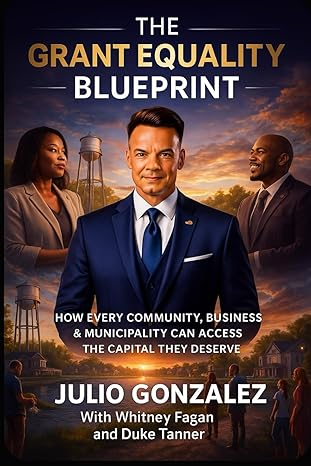
    That challenge is at the center of a growing conversation sparked by tax strategist Julio Gonzalez in his new book, The Grant Equality Blueprint. The book examines a question many leaders quietly wonder: If so much funding exists, why do so few people successfully access it?

    The Gap Between Funding and Access

    For many first-time applicants, grant funding can feel more theoretical than practical. Lengthy applications, compliance requirements, and unfamiliar terminology often discourage potential applicants before they even begin the process.

    According to Gonzalez, the issue is rarely a lack of available funding. Instead, it’s a lack of clear guidance on how the system actually works.

    After decades of working within the U.S. tax and financial systems, Gonzalez began noticing that many business owners were unaware of the grant opportunities that could support their growth. That realization led him to create The Grant Equality Blueprint as a practical guide to understanding how grant programs operate and how applicants can prepare themselves to qualify.

    Rather than presenting grants as distant or complicated programs, the book focuses on helping readers understand the structure behind them — turning what feels like an opaque process into something more navigable.

    Real Stories Behind the Opportunity

    Entrepreneur Kourtney Elizabeth Reppert contributes the foreword to the book, sharing her own experience building a career during the early days of social media. At the time, the industry had few established paths, forcing many professionals to create their own opportunities while balancing the demands of entrepreneurship and family life.

    Reppert’s perspective reflects the reality that many founders operate without clear roadmaps or financial safety nets. Her involvement in the project highlights a desire to encourage more entrepreneurs — particularly women founders — to explore funding resources that could accelerate their growth.

    Expanding Economic Opportunity

    Another voice supporting the initiative is Duke Tanner, an advocate for economic inclusion and second chances. Tanner has spent years working with individuals who lack traditional access to financial networks but still have the drive to build businesses and contribute to their communities.

    His perspective reinforces an important point: many capable entrepreneurs never pursue grant funding simply because they assume it isn’t meant for them.

    Helping people understand that these programs are accessible — with the right preparation — is a key part of expanding economic opportunity.

    Understanding the Technical Side

    Navigating grants also requires understanding the technical elements behind the process. Whitney Fagan brings that perspective through her experience working with federal funding structures.

    From documentation requirements to compliance standards, the details behind grant applications can often determine whether a proposal succeeds or fails. Fagan’s insights help translate these complex requirements into clearer guidance for applicants approaching grants for the first time.

    Using Technology to Simplify the Process

    Technology is also playing a role in making grants more accessible. Platforms like Subcity are designed to help organizations prepare for the grant process by organizing documentation, clarifying eligibility requirements, and guiding applicants through preparation steps before they submit proposals.

    Tools like these can help level the playing field for small businesses and nonprofits that may not have full-time grant writing teams.

    A Growing Conversation About Funding Access

    Together, the perspectives of Gonzalez, Reppert, Tanner, and Fagan reflect a broader shift in how people are talking about economic opportunity.

    Their shared message is simple: grant funding is not reserved for large institutions alone. With the right information and preparation, entrepreneurs, nonprofits, and community leaders can position themselves to access resources that already exist.

    As conversations about funding access and economic equity continue to evolve, The Grant Equality Blueprint adds to a larger dialogue about how public resources are distributed — and how more people can learn to participate in the systems designed to support growth and innovation.

    Readers interested in exploring the framework and ideas discussed in the book can access The Grant Equality Blueprint on Amazon:
    👉 https://a.co/d/05oHDf27

    In addition, entrepreneurs, nonprofit leaders, and prospective applicants can explore practical tools, resources, and grant readiness support through the official grant resource hub:
    👉 https://grants.engineeredtaxadvisor.com


    Angel Tuccy is a podcast host, 15-time best-selling author, and creator of the Author-licity™ and Pod-licity™ methods. She is known as the “Book Angel”. http://www.VisibilityBeforeBreakfast.com